

caiesmith
Why the Digital Switchover Matters More If You Live Far From Your Parents
The short version: By 31 January 2027, all old-style landlines in the UK switch to digital. If you don’t live close enough to check in person, you need to make one phone call now.
The One Number to Know
3.2 million UK homes still have the old phone line. That number is dropping fast. The cut-off date is fixed. No extensions.
Why This Matters More From a Distance
If you live nearby, you can just check the phone yourself.
If you don’t, you’re relying on your parent to notice a problem and tell you. That often doesn’t happen until something’s already broken.
3 Things That Could Stop Working
1. The alarm. A pendant or telecare alarm can stop working if it hasn’t been confirmed “digital-ready.”
Older alarms were built to send a signal down the old copper line. Once that line goes digital, some alarms need a small upgrade to keep working — a few need a full replacement. The only way to know which one applies is to ask the alarm company directly.
2. The phone in a power cut. By law, backup power only has to last 1 hour. Some devices last longer — but only if someone’s arranged it.
The old copper line kept working in a power cut because it was powered from the phone exchange, not your parent’s house. A digital line runs through the broadband router instead, so if the power goes off, the phone goes off too — unless there’s a battery backup device in place. The average UK power cut lasts around two and a half hours, which is longer than the 1-hour legal minimum.
3. Nothing, if it’s already sorted. Many homes have already switched with no issues. You just need to confirm it.
Millions of households have already moved over smoothly. The risk isn’t the switch itself — it’s not knowing whether your parent’s specific alarm and backup power have been checked.
What To Do This Week
☐ Call your parent’s phone provider. Ask: “Has this line switched to digital yet?”
☐ Call the alarm company (not the phone company). Ask them to confirm the alarm works on a digital line.
☐ Ask about backup power. Find out what happens in a power cut, and for how long.
☐ Set one reminder for a follow-up call in a few months.
That’s it. Four calls, ticked off, done.

Quick Answers
Will the switch happen no matter what?
Yes. It’s confirmed with no extension.
Will my parent’s number change?
No. Same number, different technology behind it.
What if the alarm isn’t ready?
The alarm company can tell you what to do — usually a free swap or upgrade.
Remember This One Thing
3.2 million landlines. One fixed date: 31 January 2027.
If you’re not local, this is one phone call today — not a project for another day.
Related Reading
Is Your Telecare Alarm Switchover-Ready? — a full checklist for testing your parent’s alarm setup step by step.
Keeping Your Landline & Router Working in a Power Cut — what backup power options exist and which is worth arranging.
Free Pendant Alarm Switchover Checker — a 2-minute tool to check your parent’s specific alarm.
Sources: House of Commons Library, Research Briefing CBP-9471 · Ofcom press release, Virgin Media £23.8m fine · Technology Reseller UK · UKPower.co.uk survey
Keeping Your Landline & Router Working in a Power Cut
The short version: new digital landlines stop working in a power cut, unlike old ones. Your provider must give you at least 1 hour of backup for free. A cheap battery pack can give you much longer.
Why this matters now
Old landlines kept working in a power cut, because they got their power down the phone line itself, not from your house.
Digital landlines don’t have that. They run through your broadband router. No electricity means no router, which means no phone line either — right when someone might need to call for help.
What you’re owed for free
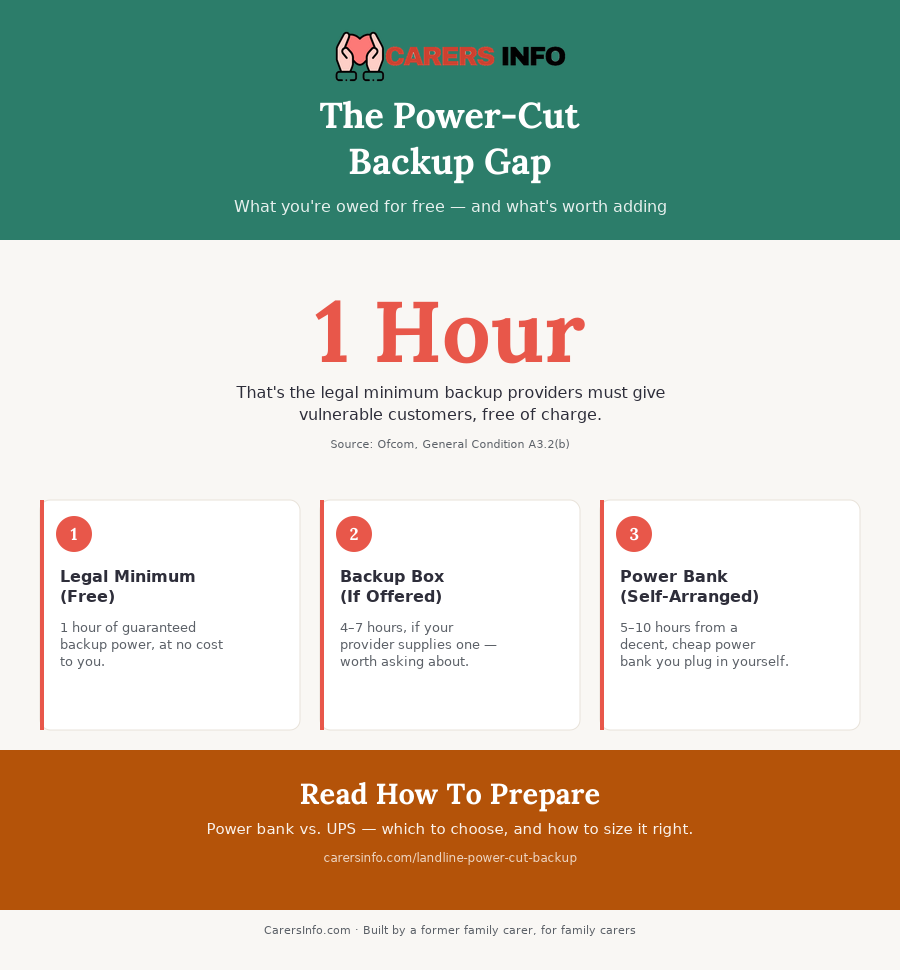
By law, your provider must give vulnerable or landline-dependent customers at least 1 hour of backup power, free of charge. Some give more — Vodafone’s backup box lasts 4–7 hours.
One hour isn’t very long, though — energy comparison site UKPower found the average UK power cut lasts just over 2.5 hours. It’s worth topping this up yourself.
Two simple options
- A power bank (like a big phone charger). Cheap, and a decent-sized one can run a router for 5–10 hours. You have to plug it in yourself when the power goes.
- A UPS unit. Stays plugged in all the time and switches over automatically — nothing for you to do in the moment. Costs a bit more.
Routers use very little power — less than one old lightbulb — so you don’t need anything big or expensive.
Anker makes both types, from small power banks for a simple top-up to larger SOLIX units for longer backup.
Compare Anker’s backup options alongside whatever your provider already gives you for free.
Sources: Ofcom (General Condition A3.2(b), 1-hour minimum backup requirement); Vodafone (Broadband Battery Backup, 4–7 hours); UKPower (average UK power cut duration); independent router power measurements. Checked September 2026.
Related Reading
Why the Digital Switchover Matters More If You Live Far From Your Parents — if you don’t live nearby, here’s how to handle this remotely.
Is Your Telecare Alarm Switchover-Ready?
The short version: UK landlines are going digital by January 2027. Some older alarms stop working when this happens. A quick check now avoids a nasty surprise later.
What’s changing
Old landlines used to get power straight from the phone exchange. That’s changing everywhere in the UK. Phones will soon run over broadband instead.
Most alarms cope fine with this. But some older ones — the kind that dial out down the old copper wire — can stop working when the switch happens. The wall socket looks the same. The alarm doesn’t warn you first.
Check this in 2 minutes
Prefer to answer a few quick questions rather than work it out yourself? Try our free Pendant Alarm Switchover Checker — 5 questions, no jargon, nothing saved or sent anywhere.
- Look at the box or manual. Words like “digital-ready,” “mobile,” “SIM,” or “cloud-based” are good. “Analogue” or “PSTN” means it may need replacing.
- Call the alarm provider. Ask: “Will this still work after the digital switchover?” A good provider will give you a straight yes or no.
- Ask your phone company when your line switches. This tells you how much time you have.
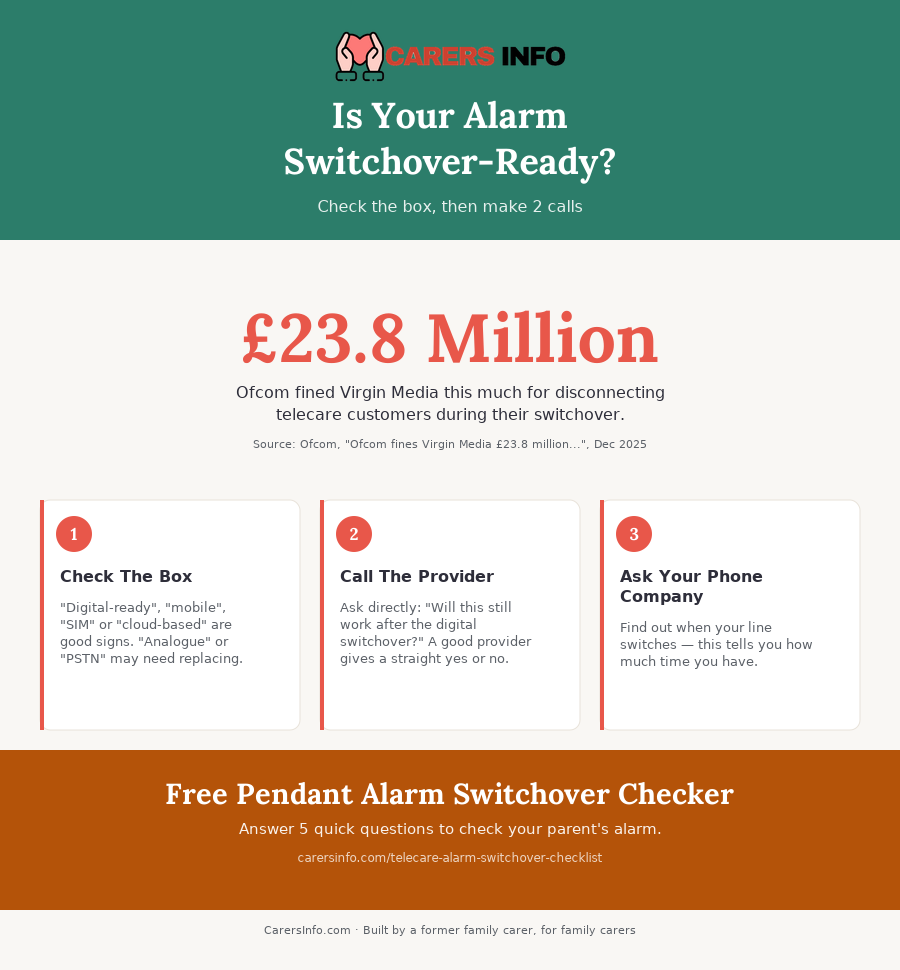
Providers are supposed to spot telecare users automatically and take extra care — but don’t assume they will. In December 2025, Ofcom fined Virgin Media £23.8 million after finding it had disconnected telecare customers during its digital switchover, leaving some alarms unable to reach monitoring centres. It’s a real rule, and a real, documented failure to follow it. Worth checking yourself rather than assuming it’s been handled.
If the alarm needs replacing
Don’t wait until the last minute. Mobile alarms (ones that use a SIM card, like a mobile phone does) avoid the problem completely — they never depended on the landline in the first place. They also work outside the house, not just near the base unit.
Affiliate link: if you buy a SureSafe alarm through a link on this page, CarersInfo may earn a commission at no extra cost to you. It doesn’t change what we recommend, and nothing in our free checkers is paid for.
SureSafe makes alarms built this way. Their SureSafeGO pendant and watch work without a landline, include 24/7 monitoring and fall detection, and can be used at home or out and about. Prices change, so check SureSafe’s site for the current cost of the alarm and the monthly monitoring.
Take a look at the SureSafeGO if an upgrade is due.
Sources: Ofcom, “Ofcom fines Virgin Media £23.8 million for putting vulnerable customers at risk of harm” (1 December 2025); House of Commons Library briefing CBP-9471; GOV.UK. Checked September 2026.
Related Reading
Why the Digital Switchover Matters More If You Live Far From Your Parents — managing this from a distance? Here’s what changes.
Getting Started with the CarersInfo Threshold Checker: Your Complete Beginner’s Guide
Watch the full walkthrough — CarersInfo.com
Essential Guide for Working Carers
Getting Started with the CarersInfo Threshold Checker: Your Complete Beginner’s Guide
CarersInfo.com · 2026/27 tax year · Earnings threshold: £204/week net
Taking on the CarersInfo Threshold Checker is a smart and proactive decision for your caregiving journey. We understand that new tools can sometimes feel a little daunting at first, especially when you’re already juggling so much. But rest assured — you’ve got this.
By the end of this guide, you’ll feel completely confident and in control of using your new Threshold Checker. This isn’t just about numbers — it’s about safeguarding your financial stability while you provide invaluable care. Let’s walk through every step together.
|
The essential facts — quickly:
|
Want the full picture? Read on for a step-by-step walkthrough of the Instant Calculator, how the Weekly Log and export work, and how often you should actually be checking. Figures shown are for the 2026/27 tax year. Always verify current rates at GOV.UK. |
Accessing Your Threshold Checker, Anywhere
Your CarersInfo Threshold Checker is designed for ultimate convenience. Simply open your web browser and go to carersinfo.com/threshold-checker. It works seamlessly on your phone, tablet, or desktop, adapting to whatever screen you have to hand.
Tip: bookmark the page now
Add carersinfo.com/threshold-checker to your browser bookmarks or home screen so it’s there instantly on payday — no searching, no delay.
Using the Instant Calculator: Step by Step
The Instant Calculator is your regular payday check. It’s designed to be straightforward and give you immediate clarity in under a minute.
|
1
|
Choose your pay frequency — Select how often you are paid from the dropdown menu: weekly, fortnightly, or monthly. |
|
2
|
Enter your gross pay — Input your income for that period before any deductions such as tax or National Insurance. This is the figure on your payslip before anything is taken off. |
|
3
|
Add pension contributions (if applicable) — If you contribute to a pension scheme, enter the amount for this pay period. Half of your pension contribution is an allowable deduction under DWP rules. |
|
4
|
Add childcare costs (if applicable) — If you have eligible childcare costs incurred while you work, enter the amount you paid for this period. |
|
5
|
Click Calculate — Your result appears immediately. The calculator tells you clearly whether your income for that period is Safe or Over the Threshold — no guesswork, no manual maths. |
The What If? Simulator: Your Proactive Shield
The What If? Simulator is designed to give you foresight and prevent problems before they arise. Use it before agreeing to any extra shifts, overtime, or new work — not after.
Simply enter the extra amount you anticipate earning and the simulator instantly shows you whether that additional income would push you over the Carer’s Allowance threshold. You get the answer while you still have a choice.
⚠️ Make this your golden rule
Every single time you are offered additional work — run the What If? Simulator before you say yes. It takes less than a minute and could save you thousands.
Understanding Your Weekly Log: Automatic Proof
One of the most valuable features of the Threshold Checker is its automatic Weekly Log. Every time you use the Instant Calculator, the system creates a dated entry in the background — no extra effort required from you.
|
What Gets Logged The date of the calculation · Your gross pay entered · Any pension or childcare deductions · Your calculated net weekly earnings · The final Safe or Over result. |
Why It Matters Should the DWP ever question your earnings, you have a clear, dated record of your due diligence. This is exactly the kind of evidence a benefits adviser or the DWP would want to see. |
Exporting Your Records: Keep Them Safe
Click the Export button inside the tool and your complete log downloads instantly as a CSV file. This opens in Microsoft Excel or Google Sheets, giving you a clean, tabular record of every check you have ever run.
Make exporting a monthly habit
Download your records at the end of each month and save them somewhere secure. You can share the file with a trusted family member or adviser, attach it to any DWP letter, or keep it as your own offline backup — all from a single click.
How Often Should You Check? Make It a Habit
To get the full benefit of the Threshold Checker, consistency is everything. Build these three checks into your routine and you will have a robust system working quietly in the background.
|
Every Payday Your regular essential check. Run the Instant Calculator as soon as you receive your payslip — before you do anything else. |
Extra Work Offered Use the What If? Simulator the moment you are asked. Get your answer before you give yours — every single time. |
Every April Carer’s Allowance rates and earnings thresholds change with the new financial year. Check for updates and make sure your figures are current. |
Haven’t started yet? Try it free first.
3 free checks included, no card required — see the calculator in action before deciding on the full version.
|
You’ve taken a significant step towards managing your Carer’s Allowance with confidence.
One payment · Lifetime access · No subscription · Or try 3 checks free first, above |
Not ready for the full tool yet? That’s okay.
Start with the free checklist instead.
A 2-minute checklist for every payday, with the current threshold and allowable deductions explained.
Your details are safe. I will never share them. Unsubscribe at any time. |
Disclaimer: Everything on this page is for general information only and does not constitute benefits, financial, legal or medical advice of any kind. Carer’s Allowance rules, rates and thresholds can change. Always verify your personal situation with the DWP, Citizens Advice, or a qualified adviser before making any decisions about your claim. Current rates: GOV.UK.
What Is the Carer’s Allowance Earnings Threshold? A Plain English Guide
Watch the plain English explanation — CarersInfo.com
Essential Guide for Working Carers
What Is the Carer’s Allowance Earnings Threshold? A Plain English Guide
CarersInfo.com · 2026/27 tax year · Earnings threshold: £204/week net
If you receive Carer’s Allowance and also do any paid work, there is one number that should be central to your financial planning: the earnings threshold. Most working carers have heard of it — but understanding its true implications can feel like navigating a maze.
This threshold is not just a guideline. It is a strict limit that can make all the difference between receiving vital support and facing significant debt. Our goal here is to demystify this critical figure — clearly, in plain English, with no jargon and no complicated maths.
|
The essential facts — quickly:
|
Want the full picture? Read on for what counts as an allowable deduction, a worked example showing the maths in full, and what actually happens if you go over. Figures shown are for the 2026/27 tax year. Always verify current rates at GOV.UK. |
Understanding the Current Threshold (2026/27)
For the tax year 2026/27, the Carer’s Allowance earnings threshold is £204 per week net. This figure is reviewed and often updated every April.
⚠️ Check every April
The threshold changes each year. Always check the official GOV.UK website after April for the latest figure: gov.uk/carers-allowance/what-youll-get
Net vs Gross: The Most Common Misunderstanding
This is where the biggest pitfalls lie. When the DWP refers to your earnings, they mean your net income — not your gross pay. This is the single most common misunderstanding, and it leads to the majority of overpayments.
Net means after deductions — not your payslip figure
Your net income is the money you have left after specific deductions have been taken from your gross pay. It is not the figure on your employment contract, and it is not necessarily your take-home pay before all personal deductions.
What Are Allowable Deductions?
The DWP allows you to deduct certain work-related expenses from your gross earnings before calculating your net income. These deductions can significantly lower your declarable income — potentially bringing you safely under the threshold.
|
Income Tax Any tax paid on your earnings is fully deductible. Many part-time carers earn under the personal allowance and pay no tax at all. |
National Insurance Your mandatory National Insurance contributions are deductible. Again, part-time carers may pay little or none depending on their earnings. |
|
50% of Pension Contributions Half of any payments you make into a personal or occupational pension scheme can be deducted. Keep records of your contributions. |
Childcare Costs Up to 50% of your net earnings can be deducted for childcare costs incurred while you are working. This is a vital support for working parents. |
|
Other Work-Related Expenses This can include costs such as specialist clothing, tools, or professional fees directly related to your employment. Keep receipts for everything. |
|
Worked Example: How Deductions Can Help
Let’s look at a realistic scenario. Imagine you earn a gross monthly salary of £900. Here is how the weekly calculation works:
|
Gross monthly earnings ÷ 4.33 = weekly gross £900 ÷ 4.33 = £207.87/week |
|
Less Income Tax & National Insurance (annual earnings £10,800 — under personal allowance of £12,570) £0.00 |
|
Less 50% of pension contributions (£45/month ÷ 4.33 × 50%) − £5.19/week |
|
Less childcare costs (£150/month ÷ 4.33) − £34.65/week |
|
Weekly net earnings = £207.87 − £0 − £5.19 − £34.65 £167.88/week ✅ SAFE Below the £204 threshold — Carer’s Allowance continues |
The same gross salary of £900 a month works out at just £167.88 a week net once allowable deductions are applied. Working all of that out accurately every week, on top of everything else you do as a carer, is simply not realistic. Which is exactly why the Threshold Checker exists.
What Happens If You Go Over — Even by a Penny?
This is perhaps the most critical thing to understand about the earnings threshold.
⚠️ All or nothing — there is no taper
If your net earnings exceed £204 in any given week — even by just £0.01 — you will lose your entire Carer’s Allowance payment for that week. There is no partial payment. No taper. Just an all-or-nothing cliff edge.
If the DWP determines you have gone over the threshold and received payments you were not entitled to, they have the right to reclaim those payments. Currently, over 143,000 carers are in this situation — with an average debt of £3,500. Some face demands of £10,000 or more.
In most cases this happens through no fault of the carer. A small pay rise, one extra shift, a bonus — none of these feel significant. But any one of them can tip the balance. And by the time the DWP letter arrives, the debt has already built up over months.
How to Check Your Own Earnings Quickly
Given the complexity of the calculation and the severe consequences of going over, regularly checking your earnings is essential. The CarersInfo Threshold Checker does the calculation for you — in about 60 seconds.
|
✓
|
Instant Calculator — Enter your gross pay, pay frequency and your allowable deductions. The tool handles the weekly conversion and the net pay calculation — and tells you clearly whether you are safe or over the limit. |
|
✓
|
What If? Simulator — Check whether extra work would push you over before you say yes. Type in the additional amount and see the result instantly. |
|
✓
|
Weekly Log — Every check is automatically saved with the date, amount and your status — building a dated proof record over time. |
|
✓
|
Export — Download your full earnings history as a file that opens in Excel or Google Sheets. Share with a benefits adviser or keep for your own records. |
Not sure yet? Try it free first.
3 free checks included, no card required.
|
Understanding the threshold is the first step. Checking your own earnings is the second — and it only takes 60 seconds.
One payment · Lifetime access · No subscription · Or try 3 checks free first, above |
Not ready for the full tool yet? That’s okay.
Start with the free checklist instead.
A 2-minute checklist for every payday, with the current threshold and allowable deductions explained.
Just me here — I’ll only use your email to send you carer-related updates. Unsubscribe any time. |
Disclaimer: Everything on this page is for general information only and does not constitute benefits, financial, legal or medical advice of any kind. Carer’s Allowance rules, rates and thresholds change every April. Always verify your personal situation with the DWP, Citizens Advice, or a qualified adviser before making any decisions about your claim. Current rates: GOV.UK.
Protect Your Carer’s Allowance: Essential Evidence for DWP Queries
Watch the full walkthrough — CarersInfo.com
Essential Guide for Working Carers
Protect Your Carer’s Allowance: Essential Evidence for DWP Queries
CarersInfo.com · 2026/27 tax year · Earnings threshold: £204/week net
Imagine this: a letter arrives from the Department for Work and Pensions. It’s asking you to account for your earnings over the past several months, perhaps even years. A wave of panic washes over you. Could you honestly prove you’ve been diligently monitoring your income to stay within the Carer’s Allowance threshold?
This isn’t just a hypothetical fear — it’s a very real concern for many unpaid carers juggling their caring role with part-time work. The thought of facing DWP scrutiny without solid proof can be incredibly stressful. But with the right tools, you can replace that worry with genuine peace of mind.
|
The essential facts — quickly:
|
Want the full picture? Read on for what good evidence actually looks like, how a weekly log can build your proof record automatically, and exactly what to do if a DWP letter arrives. Figures shown are for the 2026/27 tax year. Always verify current rates at GOV.UK. |
What the DWP Can Investigate — and How Far Back They Can Go
The DWP has the authority to review Carer’s Allowance claims going back several months or even years. They can request detailed earnings information and bank statements to verify your income during the entire period you have been claiming. If your earnings exceeded the weekly limit at any point, you could face demands to repay overpayments — and potentially penalties on top.
⚠️ “I think I was under the threshold” is not an acceptable answer
The DWP requires concrete evidence. Without it, you are left vulnerable — regardless of your best intentions or how carefully you tried to stay within the limit.
Why “I Think I Was Under” Isn’t Enough
When the DWP investigates, they are not just checking whether you were technically under the earnings limit. They also want to see that you were actively monitoring your income. Demonstrating active monitoring is key.
A dated, consistent record of your earnings checks shows diligence and intent. This can be the critical difference between a difficult penalty and a more compassionate outcome — it proves you were taking your responsibilities seriously and making a conscious effort to comply with the rules.
What Good Evidence Actually Looks Like
Effective evidence is clear, consistent, and easy to understand. When a benefits adviser or the DWP reviews your records, here is what they will be looking for.
|
Dated Entries Each check must carry a specific date. Undated records are far harder to rely on if a dispute covers a particular week or month. |
Earnings Amounts The exact net figure you earned for that period — not an estimate, not a range. A precise number shows you understood and applied the threshold rules. |
|
Status Indication A clear over or under result for each check. This shows the DWP that you were not just recording numbers but actively comparing them against the limit. |
Consistent History A continuous record over time, not just a few entries. Regular monitoring demonstrates a sustained commitment — not a last-minute scramble to look compliant. |
How the Weekly Log Builds Your Proof Record Automatically
Manually tracking your earnings is yet another task on an already full plate. That is why the CarersInfo Weekly Log is designed to build your proof record automatically — every time you run a check, it logs the essential details in the background with no extra effort from you.
What gets recorded automatically with every check
The date of the check · Your net earnings amount · Your over or under status against the £204 threshold. Over time, this builds into a complete, unassailable history — exactly the kind of dated, consistent record a benefits adviser or the DWP would want to see.
Exporting Your History — and What to Do With It
Should the DWP ever contact you, accessing your evidence takes a single click. Download your entire history as a CSV file that opens immediately in Microsoft Excel or Google Sheets — a clean, tabular record of every earnings check you have run.
|
✓
|
Share it with an adviser — Send your CSV to Citizens Advice or a benefits adviser so they can review your full earnings history and give you informed guidance before you respond to the DWP. |
|
✓
|
Attach it to any DWP letter — Include your exported history directly with any written response to the DWP, giving them clear dated evidence of your ongoing monitoring. |
|
✓
|
Screenshot key periods — Pull out specific weeks or months for quick reference if a query relates to a particular period, without having to search through a pile of old payslips. |
Don’t let the fear of a DWP letter add to your caregiving stress. Taking proactive steps to protect your Carer’s Allowance is one of the most empowering things you can do. If you have urgent questions about your claim, you can contact the DWP Carer’s Allowance Unit directly on 0800 731 0297.
Not sure yet? Try it free first.
3 free checks included, no card required — start building your record today.
|
Start your record today — and give yourself the security of knowing the proof is already there if you ever need it.
One payment · Lifetime access · No subscription · Or try 3 checks free first, above |
Not ready for the full tool yet? That’s okay.
Start with the free checklist instead.
A 2-minute checklist for every payday, with the current threshold and allowable deductions explained.
Your details are safe. I will never share them. Unsubscribe at any time. |
Disclaimer: Everything on this page is for general information only and does not constitute benefits, financial, legal or medical advice of any kind. Carer’s Allowance rules, rates and thresholds can change. Always verify your personal situation with the DWP, Citizens Advice, or a qualified adviser before making any decisions about your claim. Current rates: GOV.UK.
Should You Take That Extra Shift? What Every Carer Who Works Needs to Know
Watch the full walkthrough — CarersInfo.com
Practical Guide for Working Carers
Should You Take That Extra Shift? What Every Carer Who Works Needs to Know
CarersInfo.com · 2026/27 tax year · Earnings threshold: £204/week net
Your manager catches you on the way out. Could you do a few extra hours this weekend? Good money. You could do with it. You’re about to say yes — and then you pause. Because if you’re a working carer claiming Carer’s Allowance, that one question isn’t as simple as it sounds.
Before you answer, there is one thing you must check. This post will show you exactly what that is — and how to do it in less than a minute so you can say yes or no with confidence.
|
The essential facts — quickly:
|
Want the full picture? Read on for how one shift can quietly cost thousands, why the maths is harder than it looks, and a real side-by-side example of a safe result versus going over. Figures shown are for the 2026/27 tax year. Always verify current rates at GOV.UK. |
Why Extra Work Is Riskier for Carers Than for Most People
For most employees, taking an extra shift is straightforward — more hours, more money, no downside beyond tiredness. For a working carer claiming Carer’s Allowance, it can be a very different story.
Carer’s Allowance operates on a cliff-edge rule. There is no taper, no gradual reduction. You are either below the weekly net earnings threshold of £204 — and you keep your allowance in full — or you go a single penny over it and you lose the entire week’s payment. No other mainstream benefit works this way.
⚠️ Even £10 extra net pay can cost you your whole Carer’s Allowance for that week
If you are already close to the threshold, a modest amount of overtime is all it takes. The benefit is not reduced in proportion — it disappears entirely. That is a loss of over £86 for that week alone.
How One Shift Can Cost Thousands
Imagine you are already earning close to the threshold. You take an £80 shift on Saturday. After tax and National Insurance, your net earnings for that week nudge over £204. You lose the Carer’s Allowance for that week — but you don’t know it yet, because the DWP won’t catch the discrepancy straight away.
The data matching between the DWP and HMRC can lag by months, sometimes longer. All the while, you continue receiving payments you are no longer entitled to. When the letter finally arrives, the debt has compounded — week upon week of allowance that must now be repaid.
The maths adds up fast
Carer’s Allowance is currently £86.45 per week. If you unknowingly exceed the threshold for just 10 weeks before it is caught, that is £864.50 to repay. Over six months, it becomes over £5,187. The average carer facing an overpayment owes £3,500 — and some face demands exceeding £10,000. All from shifts that seemed perfectly reasonable at the time.
The Calculation You Must Do Before Saying Yes
Before agreeing to any extra work, you need to answer one question: will my net weekly earnings stay under £204 if I take this shift?
To work that out yourself, you would need to take your monthly gross pay, convert it to a weekly figure, deduct income tax, National Insurance, any pension contributions (half of which are allowable), and any eligible childcare costs. Then add the gross value of the extra shift, run that through the same deductions, and compare the final net figure to £204. It sounds straightforward — but it is surprisingly easy to get wrong, especially when you are tired, busy, and under pressure to give your manager an answer on the spot.
Why it is hard to do in your head
Monthly pay does not divide neatly into weeks. Tax and NI calculations shift based on your total earnings. Allowable deductions require specific DWP rules. A rough mental estimate is not good enough when the stakes are this high — you need an exact figure.
How the What If? Simulator Works
The What If? Simulator inside the CarersInfo Threshold Checker is built for exactly this moment — the moment your manager asks the question and you need an honest answer fast.
|
1
|
Enter your regular earnings — Input your usual gross pay and pay frequency. Add any allowable deductions such as pension contributions or childcare costs. The tool calculates your current net weekly figure. |
|
2
|
Add the extra shift amount — Type in the gross value of the additional hours you are considering. The simulator works out the net for you. |
|
3
|
See the result instantly — A clear on-screen result tells you whether you are safe or over the limit. Green means you are fine. Red means stop. |
|
4
|
Every check is saved automatically — The date, the figures, and your result are logged to your Weekly Log — a dated record if the DWP ever asks. |
Real Example: Safe Result vs Over the Limit
Here is how the same situation plays out with and without the simulator, using a realistic set of figures.
|
⚠️ Starting Position £190.96 £850/month gross pay with a £45 pension contribution deducted. Already close — just £5.04 from the limit. |
🚨 Add £20 Overtime £210.96 £6.96 over the limit. Carer’s Allowance lost for that week. Say yes without checking and you may not find out for months. |
✅ Add Only £4 Instead £194.96 Just under the limit. Carer’s Allowance protected. A small adjustment to the hours means you earn extra and keep your benefit. |
Without the simulator, most carers would not know the difference between the second and third scenario until the DWP letter arrived. With it, you know before you say yes.
Not sure yet? Try it free first.
3 free checks included, no card required.
|
Check before you say yes.
One payment · Lifetime access · No subscription · Or try 3 checks free first, above |
Not ready for the full tool yet? That’s okay.
Start with the free checklist instead.
A 2-minute checklist for every payday, with the current threshold and allowable deductions explained.
Your details are safe. I will never share them. Unsubscribe at any time. |
Disclaimer: Everything on this page is for general information only and does not constitute benefits, financial, legal or medical advice of any kind. Carer’s Allowance rules, rates and thresholds can change. Always verify your personal situation with the DWP, Citizens Advice, or a qualified adviser before making any decisions about your claim. Current rates: GOV.UK.
Thousands of Carers Face Crushing Debt: Understanding Your Carer’s Allowance Overpayment
Watch the full walkthrough — CarersInfo.com
Essential Guide for Working Carers
Thousands of Carers Face Crushing Debt: Understanding Your Carer’s Allowance Overpayment
CarersInfo.com · 2026/27 tax year · Earnings threshold: £204/week net
Imagine dedicating your life to caring for a loved one, only to be hit with a demand for thousands of pounds. This isn’t a rare nightmare; it’s a harsh reality for over 143,000 unpaid carers across the UK. They’re being asked to pay back their Carer’s Allowance, often facing average debts of £3,500, with some staggering sums exceeding £10,000.
This isn’t just a financial burden; it’s a profound injustice that adds immense stress to an already challenging role. Many carers feel blindsided, confused, and deeply wronged. If you are facing this situation, please know that you are not alone in this struggle. This post will help you understand how this crisis built up and what you can do to protect yourself.
|
The essential facts — quickly:
|
Want the full picture? Read on for how overpayments quietly build up, real examples of what causes them, why the system is designed this way, and four concrete steps to protect yourself right now. Figures shown are for the 2026/27 tax year. Always verify current rates at GOV.UK. |
How Overpayments Stealthily Accumulate Without You Realising
One of the most frustrating aspects of this crisis is how these overpayments build up, often without carers realising anything is wrong. The Carer’s Allowance has a strict earnings threshold that changes annually, but this crucial detail is often overlooked in the daily demands of caregiving.
Small changes, big consequences
Your earnings can fluctuate — a small pay rise, a few extra shifts, or even a one-off bonus can unexpectedly tip you over the limit. The DWP does not always notify carers promptly when this happens. By the time that dreaded letter arrives, the debt can already be substantial.
Why DWP Notifications Lag Behind
You might wonder why the DWP doesn’t flag these issues immediately. The core problem lies in the data matching process between the DWP and HMRC. This system can lag by several months, sometimes even a year or more, before income discrepancies are identified.
⚠️ Debt can build for months before you know
You could be earning slightly over the threshold, continue to receive your full Carer’s Allowance, and believe everything is fine. This isn’t through any fault of your own — it’s a systemic delay that puts carers in an impossible position, accruing debt unknowingly.
Real-Life Examples: How Small Changes Cause Big Debts
It doesn’t take much to fall foul of the rules. Consider these everyday scenarios that can lead to significant overpayments.
|
A Small Pay Rise A £20-a-week rise from your part-time job, intended to help ends meet, can push you just over the weekly earnings limit for Carer’s Allowance. |
A Christmas Bonus A modest Christmas bonus from your employer — a well-deserved recognition — can be enough to exceed the annual threshold when combined with your regular income. |
|
Extra Shifts Picking up a few extra shifts to cover unexpected expenses or save for something special can inadvertently lead to months of overpayments before you’re even aware. These seemingly minor changes, vital for many families, can trigger a cascading debt — highlighting the rigidity of the system. |
|
It’s Not Your Fault: Why the System is Broken
If you are facing an overpayment demand, it’s crucial to understand this: it is not your fault. This crisis is a direct result of a poorly designed system, often referred to as a “cliff edge” policy by experts. The government’s own independent review has confirmed these systemic flaws.
You are managing an incredibly demanding role, often with limited time and resources. Expecting carers to meticulously track every penny against a fluctuating threshold, with delayed DWP notifications, is unrealistic and unfair. This is a policy failure, not a personal one.
What You Can Do Right Now to Protect Yourself
While the system needs fixing, there are proactive steps you can take to protect yourself from these devastating overpayment demands.
|
✓
|
Check Your Earnings Weekly — Stay vigilant about your net income and compare it against the current Carer’s Allowance earnings threshold. Don’t wait until payday has passed to find out you’ve gone over. |
|
✓
|
Know Your Allowable Deductions — Certain expenses, like pension contributions or childcare costs, can be deducted from your earnings when calculating your eligibility. Make sure you’re aware of these and claiming them. |
|
✓
|
Keep a Dated Record — Document all income, expenses, and any communication with the DWP. This paper trail can be invaluable if a dispute arises, giving you clear, dated evidence of your position at every stage. |
|
✓
|
Use a Reliable Threshold Checker — The CarersInfo Threshold Checker is designed specifically for carers like you. Enter your figures and get a clear answer in about 60 seconds — before you say yes to that extra shift or accept that bonus. |
Not sure yet? Try it free first.
3 free checks included, no card required.
|
Five minutes of checking could protect thousands of pounds.
One payment · Lifetime access · No subscription · Or try 3 checks free first, above |
Not ready for the full tool yet? That’s okay.
Start with the free checklist instead.
A 2-minute checklist for every payday, with the current threshold and allowable deductions explained.
Your details are safe. I will never share them. Unsubscribe at any time. |
Disclaimer: Everything on this page is for general information only and does not constitute benefits, financial, legal or medical advice of any kind. Carer’s Allowance rules, rates and thresholds can change. Always verify your personal situation with the DWP, Citizens Advice, or a qualified adviser before making any decisions about your claim. Current rates: GOV.UK.
Are You One Penny Away From Losing Your Carer’s Allowance?
Watch the full walkthrough — 6 minutes · CarersInfo.com
Essential Guide for Working Carers
Are You One Penny Away From Losing Your Carer’s Allowance?
CarersInfo.com · 2026/27 tax year · Earnings threshold: £204/week net
The brown envelope lands on the doormat. Your heart sinks. You open it, and there it is — a letter from the DWP, not with good news, but a demand. It says you owe them money, potentially thousands, because you have earned “too much” while claiming Carer’s Allowance.
You are not alone if this scenario feels all too real, or like a looming fear. This post will shed light on why so many carers inadvertently fall foul of the Carer’s Allowance earnings limit — and, crucially, how you can protect yourself.
|
The essential facts — quickly:
|
Want the full picture? Read on for a plain-English explanation of why this happens, the common ways carers accidentally go over, what it costs if you do, and how to check your own numbers before it becomes a problem. Figures shown are for the 2026/27 tax year. Always verify current rates at GOV.UK. |
Prefer watching to reading? See how the Threshold Checker works →
Understanding the Carer’s Allowance Earnings Threshold
Carer’s Allowance comes with a strict condition: a weekly net earnings limit. For 2026/27, this threshold stands at £204 per week.
What does “net” mean?
Not your gross pay — your earnings after tax, National Insurance, and certain allowable expenses, such as half of your pension contributions and eligible childcare costs.
Keeping track of this exact net figure can be tricky, especially if your income fluctuates. This seemingly simple rule is where the complexity begins — and where most carers come unstuck.
The Cliff Edge That Catches Carers Out
The earnings limit is a cliff edge, not a tapered reduction. If your net earnings go even one penny over £204, you lose the entire week’s Carer’s Allowance.
⚠️ All or nothing — there is no taper
An additional £0.01 could mean losing over £86 for that week. This catches out thousands of carers every year.
Common Pitfalls: Why Carers Accidentally Exceed the Limit
Several common scenarios can push a carer over the threshold without them realising — small changes with big implications.
|
Pay Rises A pay rise can push your weekly net earnings past the limit — particularly around April when the National Living Wage increases. |
Overtime Extra hours to cover unexpected costs can quickly lead to an overpayment — especially if you’re already close to the threshold. |
|
One-Off Bonuses A bonus can be allocated across weeks by the DWP — potentially causing multiple weeks to exceed the limit. |
Extra Shifts Picking up an extra shift or two can easily tip the balance without careful calculation beforehand. |
The Cost of Going Over
When the DWP discovers you’ve exceeded the limit, they can reclaim weeks or months of allowance. The average debt is around £3,500 — some face £10,000 or more.
If this happens to you, it is not your fault. The system is complex and the rules aren’t always clear for someone already juggling caring and work.
How to Protect Yourself: The CarersInfo Threshold Checker
A simple way to stay on top of your earnings and avoid that dreaded letter — a clear answer in about 60 seconds, plus a record of your checks over time.
|
✓
|
Instant Calculator — enter your pay, get a clear safe/over result. |
|
✓
|
What If? Simulator — test an extra shift or pay rise before you say yes. |
|
✓
|
Weekly Log — every check saved as a dated proof record. |
|
✓
|
Export — download your history for a benefits adviser or your own records. |
Not sure yet? Try it free first.
3 free checks included, no card required.
|
Five minutes of checking could protect thousands of pounds.
One payment · Lifetime access · No subscription · Or try 3 checks free first, above |
Not ready for the full tool yet? That’s okay.
Start with the free checklist instead.
A 2-minute checklist for every payday, with the current threshold and allowable deductions explained.
Just me here — I’ll only use your email to send you carer-related updates. Unsubscribe any time. |
Disclaimer: Everything on this page is for general information only and does not constitute benefits, financial, legal or medical advice. Carer’s Allowance rules, rates and thresholds can change. Always verify your personal situation with the DWP, Citizens Advice, or a qualified adviser. Current rates: GOV.UK.
9 LPA Mistakes That Get You Rejected in 2026
If you’re putting together a Lasting Power of Attorney for yourself or someone you care for, here’s a number worth knowing before you post that form off: roughly 1 in 27 LPA applications — around 51,000 a year — get rejected by the Office of the Public Guardian, almost always over avoidable paperwork mistakes, not anything to do with the donor’s wishes.
Every rejection means the same thing: weeks of delay, sometimes a repeat of the £92 registration fee, and — worst of all — a gap where an LPA should be if something happens to the donor in the meantime. The good news is that nearly every rejection reason on record is mechanical, not medical or legal. Get the paperwork right and you avoid it entirely.
Here’s the whole list at a glance:

1Signing out of order
The donor, then the certificate provider, then the attorneys, then — if someone else is registering it — a final signature to apply. Sign any of these out of sequence and the OPG can reject the whole form, even if every signature itself is genuine.
2Section 15 signed too early
Section 15 is the final declaration used to apply to register the LPA. If it’s dated before the donor’s or attorneys’ signatures, the form is out of sequence and gets kicked back — a small dating slip with a big consequence.
3Missing signatures or dates
The single most common fault. Every donor, attorney, and certificate provider signature needs a date next to it. A page turned over and left unsigned, or a date left blank, stops the whole application.
4Witnesses who aren’t allowed to witness
An attorney cannot witness the donor’s signature — there’s a built-in conflict of interest, and the OPG checks for it. The witness also needs to be present in person at the moment of signing, not signing later “to save a trip.”
5Names that don’t quite match
“Carol” instead of “Carole.” A missed middle name. These can sometimes slip past the OPG’s own checks — and then get rejected later by a bank or care provider when the LPA is actually used, at exactly the moment it’s needed most.
6Wrong order of pages, or pages missing
LPA forms run to dozens of pages with a specific structure. A page assembled out of order, or a continuation sheet left out, is enough to invalidate the section it belongs to.
7Vague or unworkable instructions
Instructions like “look after me well” or “give reasonable gifts” have no legal meaning and can leave attorneys unable to act, or make the OPG query the form before registering it.
8Conflicting instructions between attorneys
If attorneys are appointed “jointly and severally” in one section but given instructions that only make sense “jointly” elsewhere, the form contradicts itself — and the OPG will flag it rather than guess what was meant.
9Not checking before you send it
Because so many of these faults are simple to spot once you know what to look for, the single highest-leverage step is a proper check before the form goes in the post — not after it comes back.
Prefer watching to reading? See the full 5-video LPA guide series →
That’s exactly what the LPA Form Checker does — a plain-English check through your LPA before you send it, built by CarersInfo.
- Why the Digital Switchover Matters More If You Live Far From Your Parents 13 September 2026
- Keeping Your Landline & Router Working in a Power Cut 9 September 2026
- Is Your Telecare Alarm Switchover-Ready? 9 September 2026
- Getting Started with the CarersInfo Threshold Checker: Your Complete Beginner’s Guide 3 September 2026
- What Is the Carer’s Allowance Earnings Threshold? A Plain English Guide 3 September 2026
- Protect Your Carer’s Allowance: Essential Evidence for DWP Queries 3 September 2026
- Should You Take That Extra Shift? What Every Carer Who Works Needs to Know 3 September 2026
- Thousands of Carers Face Crushing Debt: Understanding Your Carer’s Allowance Overpayment 3 September 2026
- Are You One Penny Away From Losing Your Carer’s Allowance? 3 September 2026
- 9 LPA Mistakes That Get You Rejected in 2026 28 August 2026