
9 LPA Mistakes That Get You Rejected in 2026
If you’re putting together a Lasting Power of Attorney for yourself or someone you care for, here’s a number worth knowing before you post that form off: roughly 1 in 27 LPA applications — around 51,000 a year — get rejected by the Office of the Public Guardian, almost always over avoidable paperwork mistakes, not anything to do with the donor’s wishes.
Every rejection means the same thing: weeks of delay, sometimes a repeat of the £92 registration fee, and — worst of all — a gap where an LPA should be if something happens to the donor in the meantime. The good news is that nearly every rejection reason on record is mechanical, not medical or legal. Get the paperwork right and you avoid it entirely.
Here’s the whole list at a glance:
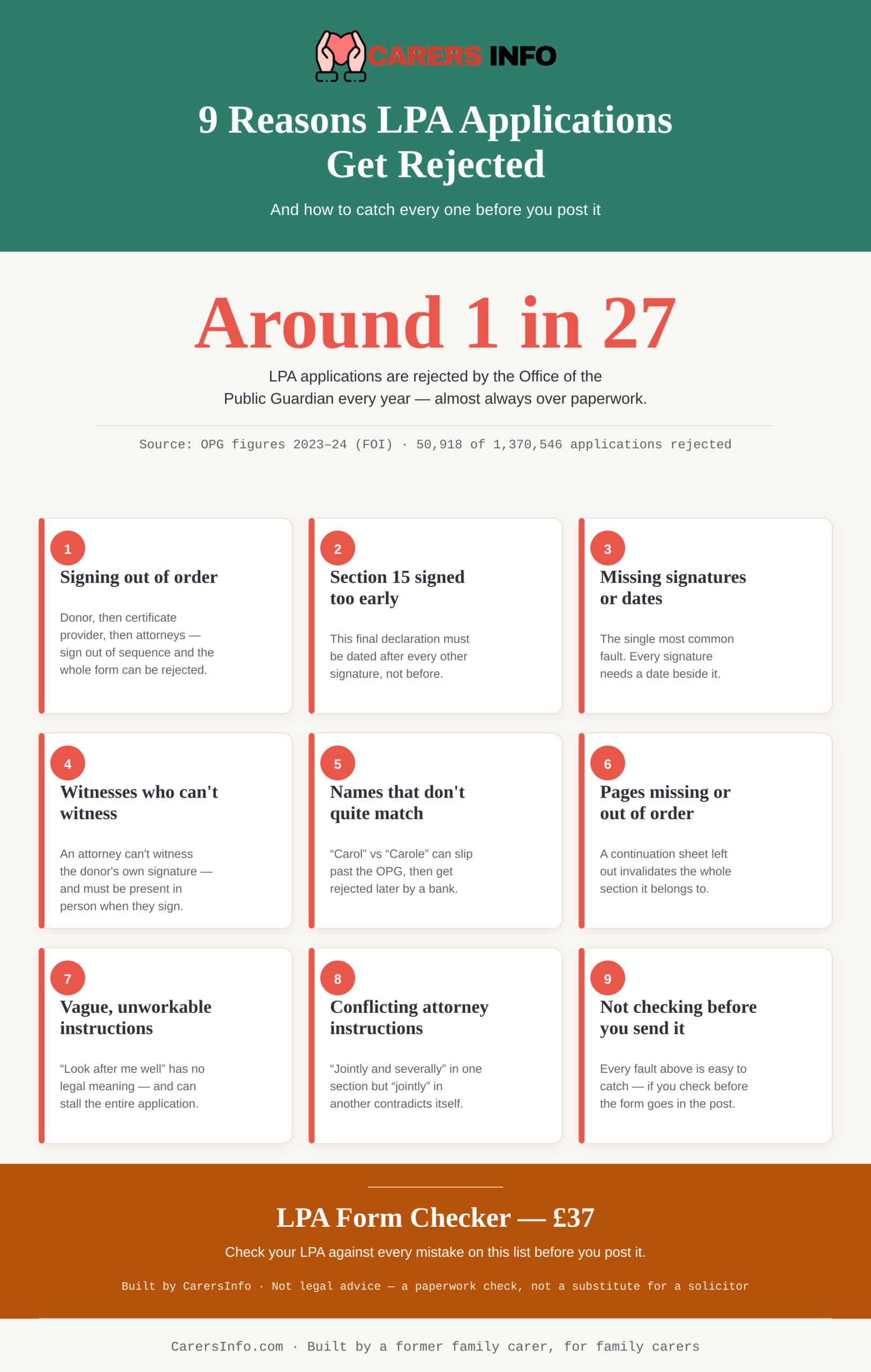
1Signing out of order
The donor, then the certificate provider, then the attorneys, then — if someone else is registering it — a final signature to apply. Sign any of these out of sequence and the OPG can reject the whole form, even if every signature itself is genuine.
2Section 15 signed too early
Section 15 is the final declaration used to apply to register the LPA. If it’s dated before the donor’s or attorneys’ signatures, the form is out of sequence and gets kicked back — a small dating slip with a big consequence.
3Missing signatures or dates
The single most common fault. Every donor, attorney, and certificate provider signature needs a date next to it. A page turned over and left unsigned, or a date left blank, stops the whole application.
4Witnesses who aren’t allowed to witness
An attorney cannot witness the donor’s signature — there’s a built-in conflict of interest, and the OPG checks for it. The witness also needs to be present in person at the moment of signing, not signing later “to save a trip.”
5Names that don’t quite match
“Carol” instead of “Carole.” A missed middle name. These can sometimes slip past the OPG’s own checks — and then get rejected later by a bank or care provider when the LPA is actually used, at exactly the moment it’s needed most.
6Wrong order of pages, or pages missing
LPA forms run to dozens of pages with a specific structure. A page assembled out of order, or a continuation sheet left out, is enough to invalidate the section it belongs to.
7Vague or unworkable instructions
Instructions like “look after me well” or “give reasonable gifts” have no legal meaning and can leave attorneys unable to act, or make the OPG query the form before registering it.
8Conflicting instructions between attorneys
If attorneys are appointed “jointly and severally” in one section but given instructions that only make sense “jointly” elsewhere, the form contradicts itself — and the OPG will flag it rather than guess what was meant.
9Not checking before you send it
Because so many of these faults are simple to spot once you know what to look for, the single highest-leverage step is a proper check before the form goes in the post — not after it comes back.
Prefer watching to reading? See the full 5-video LPA guide series →
That’s exactly what the LPA Form Checker does — a plain-English check through your LPA before you send it, built by CarersInfo.
- Why the Digital Switchover Matters More If You Live Far From Your Parents 13 September 2026
- Keeping Your Landline & Router Working in a Power Cut 9 September 2026
- Is Your Telecare Alarm Switchover-Ready? 9 September 2026
- Getting Started with the CarersInfo Threshold Checker: Your Complete Beginner’s Guide 3 September 2026
- What Is the Carer’s Allowance Earnings Threshold? A Plain English Guide 3 September 2026
- Protect Your Carer’s Allowance: Essential Evidence for DWP Queries 3 September 2026
- Should You Take That Extra Shift? What Every Carer Who Works Needs to Know 3 September 2026
- Thousands of Carers Face Crushing Debt: Understanding Your Carer’s Allowance Overpayment 3 September 2026
- Are You One Penny Away From Losing Your Carer’s Allowance? 3 September 2026
- 9 LPA Mistakes That Get You Rejected in 2026 28 August 2026