
Juggling Work and Care: A Practical Guide for Working Carers
Disclosure: This post contains affiliate links. If you make a purchase or sign up through one of these links, I may earn a small commission at no extra cost to you. I only link to products and services I consider genuinely relevant to carers. This does not influence my editorial content or recommendations.
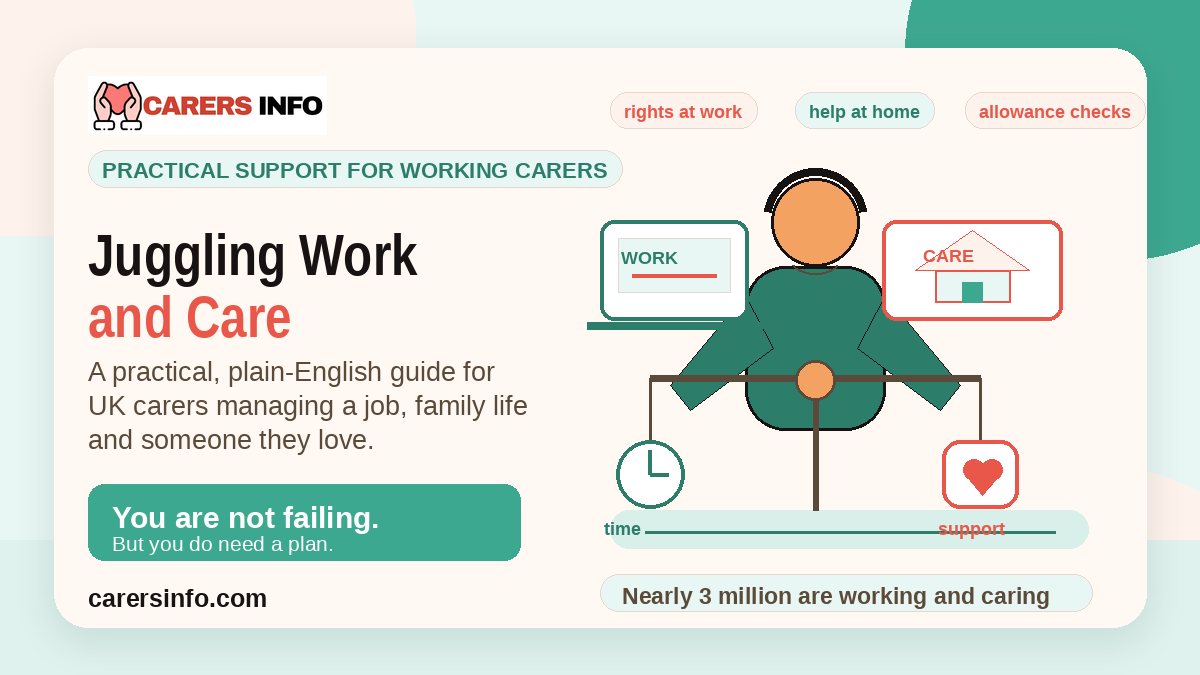
For the nearly 3 million people in the UK who are working while also caring for a loved one — managing a job, a family, and a caring role simultaneously. You are not failing. But you do need a plan. Here’s where to start.
Short on time? The essentials:
- You have the legal right to request flexible working from day one of employment — strengthened further under the Employment Rights Act 2025
- The Carer’s Leave Act 2023 gives you up to five days of unpaid leave per year — currently unpaid, with a government review into paid leave underway
- You do not have to tell your employer you are a carer — but many find that doing so unlocks practical support
- Carers UK, Carers Trust, and your local council can all connect you with services that reduce the caring load at home
- Technology — from medication reminders to video doorbells — can give you genuine peace of mind while you are at work
- If you claim Carer’s Allowance while working, check your earnings against the threshold every week — the cliff edge is unforgiving
→ Working and claiming Carer’s Allowance? Check your earnings — free Threshold Checker at CarersInfo
Want the full picture?
Read on for practical, UK-specific strategies across time management, professional help, technology, your rights at work, and protecting your own health — so that your caring role becomes something you can sustain.
You are doing two demanding things at once. This guide is about making that more manageable — not telling you to do more.
Does this sound familiar? You are managing a demanding job, running a household, and increasingly trying to hold together the daily life of someone you love. Maybe it is your mum, still fiercely independent but beginning to struggle with the things she used to do without a second thought. Maybe it is your dad, whose memory has been quietly declining for longer than you have wanted to admit. Maybe it is a partner, a sibling, or a friend.
You are caught in the middle — between work and caring, between your own needs and theirs — and you are running on not enough sleep, not enough support, and a guilt that follows you everywhere.
You are not alone. Census data shows that nearly 3 million carers aged 16 and over in the UK are in paid employment. According to Carers UK’s State of Caring 2025 survey — the largest study of its kind, with over 10,500 carers responding — 35% of working carers have already reduced their hours, and 600 people a day are giving up work to care entirely. Most are improvising. Most have never been told what they are entitled to, what help exists, or how to make this sustainable before it becomes a crisis.
This guide is for you — practical, honest, and built around how caring actually works in the UK today.
1. Time is the scarcest resource — so stop trying to manage it alone
When caring is added to a working life, time becomes something you are constantly behind on. The instinct is to try harder — to get up earlier, to take on more, to be better organised. But working carers who sustain their roles long-term are not the ones who manage time more efficiently. They are the ones who have accepted that they cannot do everything themselves, and have built a network around them accordingly.
Start by identifying what only you can do. Some tasks genuinely require you — administering a specific medication, managing finances, being present for important conversations. Everything else is, in principle, a candidate for delegation or support. Write the list honestly. Many carers are surprised by how much they have taken on by default rather than necessity.
Ask for help before you reach the edge. Family, friends, and neighbours are often willing to contribute more than carers ask them to — but they may not know where to start without being asked directly. A specific request is far easier to respond to than a general one. Instead of “it would be great if you could help more,” try: “Could you take Mum to her GP appointment on the 14th?” or “Could you sit with Dad for two hours on Saturday so I can catch up on sleep?”
Contact your local council’s adult social care team. A carer’s assessment and a needs assessment for your loved one are both free and can unlock practical support — including funded home care, day centre places, meal delivery services, and respite care. Many carers have never had either assessment. If that is you, it is worth a call.
To find your local adult social care team, search for your local council on gov.uk/find-local-council.
2. Professional help at home — what’s available in the UK
Paid home care does not mean stepping back from your caring role. For many working carers, it means the difference between sustaining that role and burning out entirely.
Home care agencies and platforms can provide carers to assist with personal care, meal preparation, medication reminders, light housework, and companionship — for as little as a few hours a week. PrimeCarers is a UK-wide platform that connects families directly with vetted, self-employed private carers — all DBS checked and interviewed — giving you more say over who you choose and often at a lower cost than a traditional agency. When using any service, look for carers registered with the Care Quality Commission (CQC), whose inspection reports are publicly available at cqc.org.uk, and ask for consistency of staff where possible — your loved one will benefit from seeing familiar faces.
NHS continuing healthcare may cover care costs entirely if your loved one has a primary health need. Ask your GP or district nurse whether a continuing healthcare assessment would be appropriate.
Direct payments allow your loved one (or you as their carer, in some circumstances) to receive a cash sum from the local council to arrange care independently, rather than accepting council-arranged services. This gives more flexibility over who provides care and when.
Respite care — whether at home, in a day centre, or in a residential setting for a short period — is specifically designed to give carers a break. It is not a last resort. It is a recognised part of sustainable caring, and your local council may contribute to or fully fund it following a carer’s assessment.
For help navigating these options, Carers UK (0808 808 7777, free, Monday to Friday 9am–6pm including Bank Holidays) and Carers Trust can both connect you with local services and explain what you may be entitled to.
3. Technology that can give you peace of mind while you’re at work
One of the most persistent anxieties for working carers is not knowing what is happening at home while they are away. A set of relatively simple and affordable technologies can meaningfully reduce that anxiety — and in some cases genuinely improve safety.
Medication management: Missing or doubling medications is one of the most common and serious risks for people living alone with a health condition. Automatic medication dispensers with built-in alarms and locking drawers mean your loved one takes the right tablets at the right time — and some models send an alert to your phone if a dose is missed. These are available from several UK suppliers and pharmacies, and some local authorities include them in assistive technology schemes.
Simple mobile phones: If your loved one struggles with a modern smartphone, a dedicated big-button phone can make all the difference. TTFone makes a range of easy-to-use mobile phones designed specifically for elderly and disabled users — large tactile buttons, clear high-contrast screens, loud volume, and straightforward calling without the confusion of apps or notifications. Some models include a dedicated SOS emergency button for added peace of mind.
Smart speakers and voice assistants: Devices such as the Amazon Echo or Google Nest allow your loved one to make calls, set reminders, and even contact you hands-free — without needing to navigate a phone. For people with limited mobility or dexterity, this can provide a meaningful degree of independence and connection.
Video doorbells: A video doorbell allows you to see and speak to anyone at your loved one’s door from your phone, wherever you are. This is particularly useful for people who struggle to get to the door quickly, or who may be vulnerable to doorstep callers.
Smart home sensors and falls detection: Motion sensors that send an alert if there has been no activity in the kitchen by a certain time, or dedicated falls detection devices worn as a pendant or wristband, are increasingly affordable and widely available in the UK. The Careline and Lifeline alarm services are long-established providers, and many local councils operate their own community alarm schemes at low cost.
Telecare through the NHS and local councils: It is worth asking your local council or GP surgery about telecare packages — these often bundle several assistive technologies together and may be partially or fully funded following an assessment.
Technology is not a substitute for human care. But used thoughtfully, it can extend the hours between visits, reduce anxiety during the working day, and help your loved one maintain independence for longer.
4. Your rights at work — what the law gives you
Many working carers are not aware of the legal protections they have — and as a result, they either struggle in silence or make decisions about work without understanding their full options. The landscape changed significantly in late 2025, when the Employment Rights Act 2025 received Royal Assent in December — the most significant overhaul of UK employment law in a generation. Some of its provisions are already in force; others are being phased in through 2026 and beyond.
The right to request flexible working has applied from an employee’s first day since April 2024, and the Employment Rights Act 2025 strengthens this further by tightening the rules on employer refusals. You can request a change to your hours, your working pattern, or your location. Your employer must consider the request seriously and has two months to respond. They are not required to agree, but they must have a recognised business reason for refusing. Flexible arrangements — compressed hours, later starts, remote working on certain days — can make a profound difference to the manageability of a caring role.
Carer’s Leave gives employees the right to take up to five days of unpaid leave per year for caring responsibilities, available from the first day of employment under the Carer’s Leave Act 2023 (in force since April 2024). You do not need to provide evidence of your caring role, and you can take the leave in individual days or half-days. It is a minimum — your employer may offer more, and some already do offer paid carer’s leave voluntarily.
Important: this leave is currently unpaid as a statutory baseline. Carers UK’s research found that half of working carers are unable to take the leave because they cannot afford to go without pay. The government has committed to reviewing the case for paid carer’s leave, and Carers UK is actively campaigning for five days of statutory paid leave. This is an area to watch — but for now, unpaid is the legal minimum.
Emergency dependants leave is a separate right covering unexpected situations involving a dependant — such as a sudden deterioration in your loved one’s condition or a breakdown in care arrangements. It is unpaid by default and is intended for short-term emergencies rather than planned absence.
Discrimination protection: Carers are not a protected characteristic under the Equality Act 2010 in themselves — but discrimination based on your association with a disabled person is unlawful. If you are treated less favourably at work because of your caring responsibilities for a disabled loved one, you may have legal grounds for a complaint. Citizens Advice can help you assess whether this applies to your situation.
Telling your employer you are a carer is a decision only you can make. Many carers worry it will affect how they are seen professionally. In practice, employers who are made aware often find it easier to make practical adjustments — and many have dedicated carer policies or Employee Assistance Programmes with additional support. Carers UK publishes guidance on how to approach this conversation.
5. If you claim Carer’s Allowance while working — one critical rule
If you receive Carer’s Allowance alongside your employment, there is one rule you cannot afford to overlook.
The earnings limit for Carer’s Allowance in 2026/27 is £204.00 per week after allowable deductions. Go one penny over that limit in any given week and you lose the entire £86.45 for that week — not just the excess. There is no taper. This is sometimes called the cliff edge, and it catches working carers out every year.
A small pay rise, a single shift of overtime, or a bank holiday worked can push you over without warning. Thousands of carers have built up overpayment debt as a result — sometimes going back years — without realising it was happening. The DWP announced in November 2025 that it is reviewing overpayment cases going back to 2015.
The free CarersInfo Threshold Checker calculates your position in under a minute, adjusting for income tax, National Insurance, pension contributions, and care costs. It also lets you log your earnings week by week, building a record that is invaluable if the DWP ever raises a query.
→ Check your earnings against the Carer’s Allowance limit — free Threshold Checker at CarersInfo
6. Looking after yourself is not optional
There is a version of this section that lists stress management techniques and reminds you to eat well and exercise. That version is not wrong, but it misses the more important point.
The Carers UK State of Caring 2025 survey found that 74% of carers feel stressed or anxious, 42% say their physical health has worsened since they began caring, and 49% have cut back on essentials such as food and heating. These are not the numbers of people who are coping. They are the numbers of people who are absorbing the cost of caring in their own bodies and bank accounts, because no one has told them there is another way.
Working carers who sustain their roles long-term are not the ones who somehow manage not to get tired. They are the ones who have accepted that their own health is not a luxury to be attended to after everything else is done. It is a prerequisite for everything else continuing.
Your GP can refer you to a carer support worker in many areas. Your employer’s Employee Assistance Programme, if they have one, typically includes free confidential counselling. Carers UK’s online forum and helpline are available when the feelings that come with a caring role — the resentment, the loneliness, the grief while someone is still alive — become too heavy to carry alone.
You are not supposed to do this alone
The working carer who is managing perfectly, without support, without difficulty, without cost to themselves — that person does not exist. What does exist are carers who have found a combination of practical support, professional help, and honest self-awareness that makes their situation more sustainable.
Start with one thing on this list. A carer’s assessment. A conversation with your employer. A call to Carers UK on 0808 808 7777. A check of your Carer’s Allowance position. One thing is enough for today.
You are already doing more than most people will ever understand. Let some of it be shared.
→ Access all CarersInfo Practical Support guides — free in the dashboard
© CarersInfo 2026. This post provides general information and is not a substitute for professional legal, benefits, or social care advice. Statistics from Carers UK State of Caring 2025 and Census 2021. Employment rights information reflects the Employment Rights Act 2025 and is correct as of May 2026; provisions are being phased in and some may change. For personal advice on your situation, contact Carers UK (0808 808 7777, Monday to Friday 9am–6pm), Citizens Advice, or your local council’s adult social care team.
Affiliate disclosure: This post contains affiliate links to PrimeCarers and TTFone. I may receive a commission if you make a purchase or sign up via these links. There is no additional cost to you. Affiliate relationships do not influence the information or recommendations in this post.
- Juggling Work and Care: A Practical Guide for Working Carers 22 May 2026
- The Best Mobile Phone for Elderly Parents 23 April 2026
- Care Homes 21 April 2026
- Later Stage 21 April 2026
- Money and Legal 20 April 2026
- Your Wellbeing 20 April 2026
- Why 1 in 11 LPA Applications Gets Returned — And the Check Most Families Never Do 19 April 2026
- Support Services 19 April 2026
- Daily Care 18 April 2026
- Communication 17 April 2026
- The Carer’s Allowance Earnings Trap — And How to Stay Safe 16 April 2026
- From Care To Carer: The Moment I Realised My Life Had Changed — And Why I Built CarersInfo 14 April 2026
- Your First Steps As A Carer 13 April 2026
- Getting Started with the CarersInfo Threshold Checker: Your Complete Beginner’s Guide 6 April 2026
- Protect Your Carer’s Allowance: Essential Evidence for DWP Queries 6 April 2026
- Should You Take That Extra Shift? 2 April 2026
- Why Thousands of Carers Are Being Asked to Pay Back Their Carer’s Allowance 2 April 2026
- What Is the Carer’s Allowance Earnings Threshold? Plain English Explained 26 March 2026
- Are You One Penny Away from Losing Your Carer’s Allowance? 26 March 2026
- End of Life Care Planning Tips for Caregivers 17 December 2024
- Caregiver Resources and Eligibility for Services 17 December 2024
- Navigating Lack of Support for Caregivers: A Guide to Overcoming Challenges 17 December 2024
- Caregiver Tips for Balancing the Needs of Healthy and Sick Family Members 17 December 2024